
'This was undoubtedly a premeditated strategy to thwart India's entry into the NSG.' 'If India hopes to be a major player, it must use its rising clout on the world stage to influence amenable members of the group to alter such discriminatory practices and ensure fair rules of engagement,' says Vivek Gumaste.
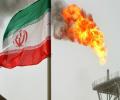
Iran is preparing for a trade and investment boom that could reshape the region after agreeing with world powers to curb its nuclear programme, paving the way for sanctions that have stifled its economy to be lifted.

R K Narayan's house has been preserved as a simple museum with his memorabilia, thanks to the imagination of a commissioner of Mysore, who stopped its sale by RKN's successors to a property developer and purchased it for the government.

Indian and American experts on Wednesday held detailed discussions on a range of implementation issues, including administrative, liability, technical and licensing matters to advance the operationalisation of Indo-US civil nuclear cooperation that has been in limbo for past 9 years.

'I would urge my Indian friends to look at how significant the overall support was.'

Prime Minister Narendra Modi and United States President Barack Obama will meet on Sunday, January 25, at Hyderabad House a few hours after the American leader's arrival in New Delhi.

'He always had a choice to resign and walk toward the sunset in protest.' 'Instead, he chose to be a mute witness to one of the most sordid chapters of India's parliamentary history when MPs were bought up like cattle to steer the nuclear deal through,' says M K Bhadrakumar.

Although the pact would focus mainly on the Pacific and the South China Sea region, any action designed to deter China with or without New Delhi's active participation is a welcome move, notes Commodore Venugopal Menon (retd).

A radiation scare at Delhi's Indira Gandhi International Airport forced the suspension of cargo operations, but nuclear regulator and Delhi authorities said there was no leak of radioactive substance from a consignment unloaded from a Turkish Airlines plane.

The joint statement issued after Prime Minister Narendra Modi and President Barack Obama's first-ever summit is high on intent and ambition. Notably missing from the statement is India's refusal to be America's partner in its war against ISIS.

The agreement was reached in intensive negotiations between contact groups that Obama and Modi had set up in September.
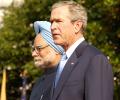
'If we could break through this symbolic barrier of sanctions and a dysfunctional relationship, we could do anything.'

The powerful United Nations Security Council on Monday unanimously adopted a resolution that endorses the landmark nuclear deal between Iran and six world powers.

India has a 'natural global partnership' with US, says PM.

'The onus is now on China to explain to the world why it feels Pakistan should accompany India on the question of NSG Membership!! China's not so covert help for Pakistan's nuclear weapons and ballistic missile programmes will stand exposed,' says former ambassador G Parthasarathy.

If these reports are true, it means that it possesses something much more powerful than it has tested in the past. North Korea has run nuclear tests in the pasts, but this announcement has sent panic waves internationally.

To imagine that no one contributed to global peace to deserve the prize in 2017 is to be extremely cynical about peacemakers around the globe.
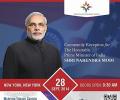
'Unlike Japan and China, the US has a long relationship with India. He is going there to fly the Indian flag in a gesture of friendship. This is a journey like none other, meant to signal that the two democracies are in a defining relationship of the 21st century.'
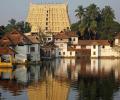
Two decisions handed down by the Supreme Court have spread gloom in Kerala as they have shaken two basic faiths of a majority of the people in the state, says T P Sreenivasan.

'From envy, heartburn and broken hearts to broken marriages, much damage has been done by unintended revelations in the social media. Suspicious partners bring out hidden relationships, which may never have come to light and hell breaks lose in many lives,' warns T P Sreenivasan.

'If ever India loses its patience after repeated terror attacks and decides to retaliate against the terrorist camps, Pakistan may term that a conventional military attack and invoke the nuclear option. This is a way to continue with terrorism without retaliation.'

'Castro told us: "Give me a thousand Gurkhas and I shall keep my neighbour under control!"' 'We pretended that we did not know which neighbour he meant.'

From early indications, the Modi government's foreign policy seems to be pragmatic and reciprocal, says K G Suresh.

PM Modi seems to be gradually ending India's strategic ambiguity

No theory would ever justify the public humiliation of the acting head of the consulate of a friendly country. Whatever be the eventual solution, grievous damage has been done to her personally and to the relations between the two countries, says Ambassador T P Sreenivasan.

It is unconscionable to choose between Sardar Patel, who united India physically, and Indira Gandhi, who gave meaning, content and pride to the unity of the nation and became a martyr at the altar of national unity, says Ambassador T P Sreenivasan.

Negotiating a sustainable compromise with Iran is not getting any easier, and this delay might not yield the desired result of bringing Tehran's nuclear programme under stringent limits, says Claude Smadja
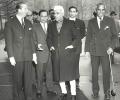
'Rightly or wrongly, 1962 got ascribed to Krishna Menon and him alone. That's unfair.' 'Certainly, he was one of the guilty men, but he was not the only guilty man. Mistakes were made all around.'

'I am doing all this for the students of Kerala, and when they come and hit me, it is very frustrating.' 'My regret is that something that could set off for the future has been thwarted.' 'We have not changed the syllabus for decades, we have not accepted norms in education and technology is hardly used. Today's students are studying what I studied decades ago.'

The reversal of Trump's policy with regard to Iran, like the withdrawal from the Paris Agreement, may not be a matter of just turning the clock back, but one of patient negotiations, with uncertain consequences in the post-COVID-19 world, observes Ambassador T P Sreenivasan.
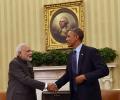
Furthering Indo-US cooperation on terrorism, Prime Minister Narendra Modi and President Barack Obama on Tuesday agreed to make "joint and concerted efforts" to dismantle safe havens for terror and criminal networks like Lashkar-e-Tayib, Jaish-e-Mohammad, Dawood-company, Al Qaeda and the Haqqani network.

Making nuclear exemptions for India, says Senator Edward Markey, 'only infuriates Pakistan and leads them to further increase their own nuclear capacities.'

T P Sreenivasan was India's high commissioner in Fiji in 1987, when Sitiveni Rabuka toppled the Indian-dominated government there. Ambassador Sreenivasan stayed on for two years after the coup, fighting for the rights of the people of Indian origin before he was expelled by Rabuka. 'Meeting Sitiveni Rabuka, who had overthrown a democratically elected government, discriminated against the Fiji Indians, brought untold humiliation and suffering to them, tried to disenfranchise them, ordered me out of Fiji and closed down the Indian high commission was a difficult decision to take even after 25 years,' notes Ambassador Sreenivasan who eventually caught up with Rabuka over a game of golf.

Prime Minister Modi felt there were too many silos with no arrangement to take a comprehensive view on national security. The PM has entrusted NSA Ajit Doval to evolve a comprehensive roadmap and get it implemented, reveals Nitin Gokhale, Editor-in-Chief, Strategic News International.

Moving ahead with their new mantra -- Chalein Saath Saath: Forward Together We Go -- Prime Minister Narendra Modi and United States President Barack Obama on Tuesday vowed to deepen cooperation in every sector for the benefit of global stability and people's livelihoods over the next ten years.

... and ONE man could be the reason for that, say scientists.

India and Russia on Thursday decided to expand cooperation in various sectors as they signed 16 pacts, including on joint manufacture of 226 military helicopters.

'I would like to request the AERB, UCIL and DAE to introspect. The world is changing, so is India. The wave of development and modernity will not stop for those who continue to live in the past. The future belongs to the youth who believe in the values of honesty, transparency and efficiency.'

This is the joint statement issued by the ministry of external affairs on the visit of US President Barack Obama to India.

India and Iran on Monday decided to jointly combat terror, radicalism and cyber crime as the two strategic partners signed 12 agreements including a "milestone" pact on developing the key Chabahar port for which India will provide $500 million.
